




You may have just been diagnosed with epilepsy, or perhaps you have had it for a long time, and are thinking of changing jobs. Or you might be fresh out of college and are applying for your first job. Maybe, your seizures are now controlled because of your medications, or you have been seizure-free for some time and are thinking of going back to work. Naturally, you may be wondering whether your epilepsy will stand in the way. The good news is that you might be able to, and we hope this article will help you understand how.
There are many kinds of epilepsy, each having different effects on people. The WHO lists some common symptoms of epilepsy to generally include:
- Loss of consciousness
- Dizziness
- Flapping of arms
- Nausea
- Inability to speak
- Not knowing what’s happening around you; amongst others [1].
If your epilepsy has been well controlled with medications, then you should be able to work at any type of job. If your epilepsy sometimes causes you to feel nauseous or dizzy, you may still be able to do some kinds of jobs that don’t require a lot of physical and mental activity and that wouldn’t risk your safety. According to the Epilepsy Foundation, many people living with epilepsy are working at a wide range of different jobs, so you’ll just have to find one that is right for you. [2]
You should consider that if you have occasional seizures, then it’s best to look for jobs that don’t require you to drive. Aside from that, you can look into applying for jobs like teaching, healthcare, support roles, etc, based on your qualifications and the frequency of your seizures. For example, Kirsty, an Embrace user, works full-time, while Emily, another Embrace user, also works full-time at a hospital and is an aspiring writer.
It may feel hard to work if you are constantly feeling tired because of your epilepsy, but you should feel confident to speak to your employer about it and see whether there are ways to adjust your role or work conditions [3]. For example, they might adjust your shift or help you work at your own pace.
Things to do while working with epilepsy
- Consider talking to someone about your condition, and educate them on what to do if you have a seizure: It is your decision whether or not to speak with your employer about your epilepsy, especially if it doesn’t stand in the way of your job, but you might need to open up to a colleague that you can trust. This is important so that they’ll know what to do if you have a seizure at work.

- Have an emergency action plan: We recommend that you have an emergency plan containing your seizure information to help you manage your epilepsy better or to let people know what to do when you have a seizure emergency. It can be adapted to suit any situation in your life and should be kept handy. The Epilepsy Foundation, for example, has a downloadable seizure response plan (SRP) that you can fill out with the help of your doctor and caregivers.

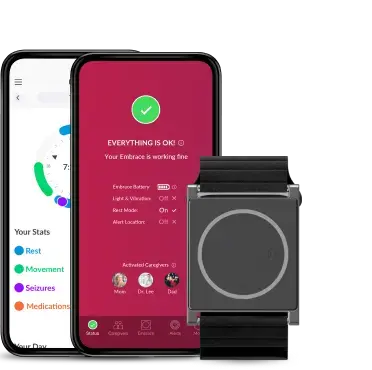
- Seizure monitoring devices: A device that can help in monitoring seizures and alerting caregivers when you are having a seizure can be a helpful tool to have. Most seizure monitoring devices like Embrace might be able to detect and send alerts when you’re having a possible convulsive seizure. This way, your caregivers will not need to worry about not knowing when you’re having one. Embrace2 is FDA-cleared in the USA, and you can watch this video to discover how it works.

- Don’t forget to take your medication: Medication is very important for seizure management and control. Studies have shown that about 70% of epilepsy patients have controlled their seizures through medication [4]. You can set daily reminders for yourself to always remember to take them on time.

- Get enough rest: Take a break if you need one. When you notice that you are becoming stressed, ask your employer for some time to rejuvenate. For this reason, you might want to consider informing your employer about your condition beforehand, so they can make certain exceptions for you. If you have an Embrace watch, you can use the Mate App to better keep track of your rest patterns daily and to know when to make adjustments, if necessary.*

- Keep a diary to better keep track of your seizures and the triggers: Having a simple paper diary might suffice, or if you have an Embrace, you can also use the Mate App to better keep track of your seizures. You can show this seizure diary to your doctor so that they can recommend the appropriate treatment for you.

Benefits for people with epilepsy
For those who are less able to work because of their epilepsy, your local government may offer benefits, depending on your country's policy. In the US for example, you may be able to claim Social Security disability benefits, by providing detailed medical evidence about your epilepsy. In the UK, you can also apply for the Employment Support Allowance (ESA) to support you while working.
For benefits in other countries, you can get information on how you can be supported through epilepsy support groups or the government website of your country.
Know your Rights
It may feel disheartening if discrimination occurs, especially if you have told your employers and colleagues about your condition and didn’t get the reaction and support that you were expecting. Certain laws cover epilepsy patients in this regard, and, like the benefits, it varies from country to country. In the USA, for example, there’s the Americans with Disabilities Act (ADA), which demands that all workers should be treated equally and not discriminated against based on their disability, epilepsy included. The UK also has the Equality Act (2010) to protect workers with disabilities, and so do most other countries.
If the frequency of your seizures increases or if they become uncontrollable, it may be advisable to stop working to avoid posing any danger to yourself. Check with your local community for disability benefits that you might be eligible for to give you support.
We know that living with epilepsy can be difficult, so don’t hesitate to reach out to people around you who also have epilepsy to gain support from them. You can also read some Embrace user stories here to gain some inspiration.
If you have epilepsy and still go to work, feel free to share your story with us by posting it on Facebook/Instagram and tagging our page (@Empatica on FB, @empatica_wearables on IG) or use the hashtag #MyEmbraceStory We’ll love to hear from you!
All the best!
*Disclaimer: The Mate App is not intended to make any diagnostic or treatment recommendations based on sleep or activity tracking, but instead, it can give you insights on your overall rest and physical activity.
Words worth reading
References
- https://www.who.int/news-room/fact-sheets/detail/epilepsy
- https://www.epilepsy.com/living-epilepsy/independent-living/employment/finding-employment
- https://www.epilepsy.com/living-epilepsy/independent-living/employment/disclosing-epilepsy
- Bazil CW, Morrell MJ, Pedley TA. Epilepsy. In: Rowland LP, editor. Merritt’s Neurology. 11th ed. Philadelphia: Lippincott Williams & Wilkins; 2005. pp. 990–1008.