


Her intriguing and inspirational talk will change how you think about AI.
Rosalind W. Picard is founder and director of the Affective Computing research group at the MIT Media Lab. She's also a recently elected member to the National Academy of Engineering, one of the highest professional distinctions for engineering. And it's only one among many other notable recognitions she’s received. She’s also a brilliant speaker, capable of making complex concepts easy to understand.
On the topic of AI, Dr. Picard knows more than most. She pioneered a branch of computer science known as Affective Computing, which is often referred to as Emotion AI.
Design helps facilitate the interaction between humans and AI. See some of the ways in which we’ve helped users accomplish their goals by integrating design and AI: The importance of design in healthcare systems
Join our efforts in supporting AI-powered technology to meaningfully improve people's lives. Even though it's at the forefront of innovation, AI shouldn't be limited to only those that can afford it. We're committed to getting Embrace to those most in need. If you're interested in getting involved in this effort, please email donate@empatica.com for more information, or donate an amount of your choice directly to Danny Did Foundation
Embrace2 and its life-saving potential
Dr. Picard starts her talk by telling the story of a mother who lost her 4-year-old son due to SUDEP (Sudden Unexpected Death in Epilepsy).
This isn't mentioned in the TED Talk, it's something that she shared with us personally that we thought was important to add.
“When I first heard this story about losing her son, it made me cry. I had to leave the room as it moved me so much. For years and years, until we built Embrace, every night when I would tuck my little sons in bed I would remember her story and I knew that I could never rest until we got Embrace built and deployed. I never felt it was fair that I had sons who were healthy when so many families with epilepsy suffer so much. I felt that the (undeserved) gift of time of not having to deal with pediatric or family medical challenges meant I should use my energy and time to help those who were struggling to manage those needs.”
Back to the TED talk, Dr. Picard explains, “SUDEP is when an otherwise healthy person with epilepsy dies, and they can’t attribute it to anything they can find in an autopsy. There is a SUDEP every 7 to 9 minutes.”
She goes on to describe what occurs in the brain when a seizure occurs, “When you have a seizure there is a bit of unusual electrical activity, and it can be focal and take place in just a small part of your brain. When that happens you might have a strange sensation. However when you have a seizure where that [electrical activity] spreads like a forest fire, it generalizes, and that generalized seizure takes your consciousness away and causes you to convulse.”
A breakthrough discovery
In her research group at the MIT Media lab, they were focused on stress measurement with a wrist-wearable. To her surprise, she found a huge peak in electrical activity on one wrist, which was triggered by a grand mal seizure. At the time it looked like it happened many minutes before the seizure. Later, with more precise timing and synchronization, and many more people measured in an epilepsy monitoring unit, it was discovered that usually the activity measured on the wrist starts around the same time as the activity measured in the brain. When you couple skin conductance with movement data, these can be used to train machine learning to build an automated AI that detects these patterns much better than just a shake detector.
The exciting findings on how electrodermal activity (changes in the sweat gland activity) arise on the wrist led to information that could potentially improve a wrist-worn seizure detector.
Putting the idea into action
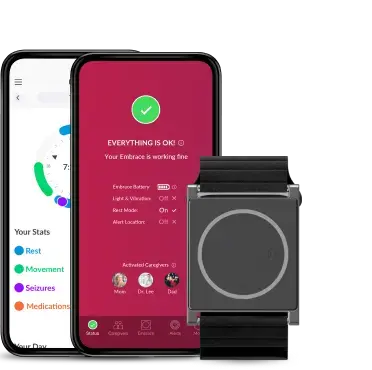
This is where the idea for Embrace was born. An AI seizure detection algorithm, built using machine learning, that’s programmed into a sleek and attractive watch. And when a generalized tonic-clonic seizure is detected, it communicates with its paired smartphone to send alert calls and texts to caregivers so they can quickly come to assist.
To quickly understand how Embrace works, watch our animated video.
“SUDEP is most likely to happen after a generalized tonic-clonic seizure. And when it happens, it doesn’t happen during the seizure, or immediately afterwards. But, afterwards when the person just seems very still and quiet they may go into another phase where the breathing stops, and then some time later the heart stops. So there’s some time to get somebody there [to help].”
Preventing SUDEP
Having someone there to assist during a seizure is not guaranteed to prevent SUDEP; however, it does reduce the risk¹. That person can not only prevent you from further injury during the seizure, but also monitor you to make sure you’re breathing afterwards. Dr. Picard finishes her talk by sharing the story of a mom who was in the shower when she received an alert call from Embrace.
“She gets out of the shower and goes to her daughter’s room, where she finds her face down, having a seizure, blue and not breathing. She flips her over, and her daughter takes a breath, and another breath. And her daughter turns pink and is fine.”
This little girl and her wonderful family are a reason that AI should continue to be built. And all who suffer from unexpected grand mal seizures, and their families, are reasons why AI should be built. When AI and people work together, we can make lives better, and even save them.
If you’re curious to hear about how Embrace has come through in others’ time of need, check out the Stories section of our blog.
Words worth reading